
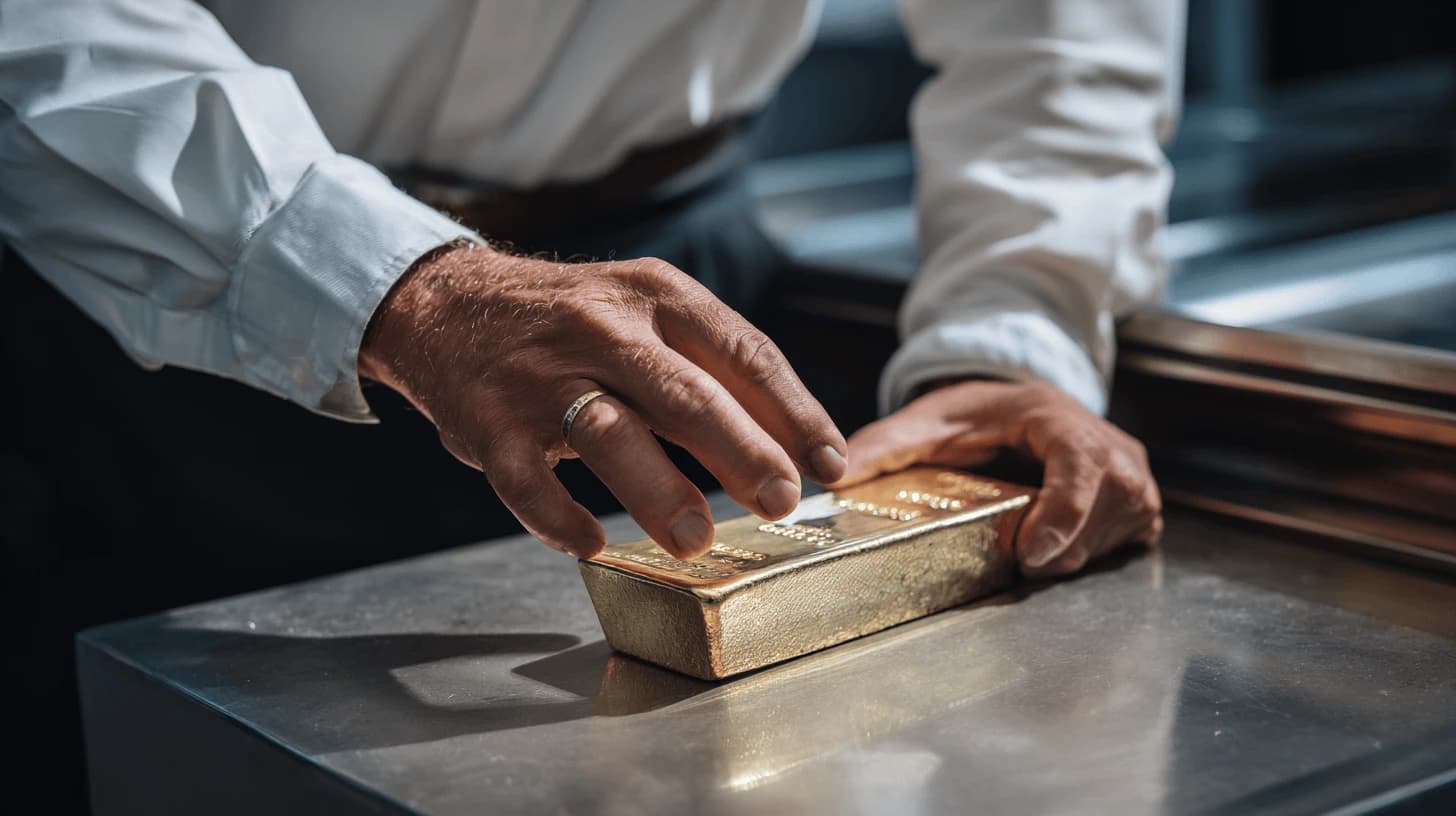
If you have held Bitcoin through the 2024–2026 run, you are sitting on the kind of gain that changes what the position means. At some point a BTC stack stops being a bet and starts being a meaningful share of your net worth — and a net worth that can move 10% in a week is a net worth you do not fully control.
This page is for the holder who has already decided to take something off the table and wants to do it without wiring proceeds through a bank, without parking in a stablecoin that is just another counterparty, and without buying a token that merely points at gold. Bitcoin in, physical allocated gold out. On-chain, direct, documented.
Ballast, Not Betrayal
Let us deal with the psychology first, because it is the real obstacle — the mechanics are easy.
Many Bitcoin holders treat any conversion out of BTC as a loss of conviction. It is not. Conviction is a thesis about the future; ballast is what keeps you solvent and calm while the thesis plays out. The holders who survive full cycles are rarely the ones who kept 100% exposure at every peak. They are the ones who periodically converted part of an outsized gain into something that does not participate in drawdowns.
Gold is the natural ballast for a Bitcoin portfolio precisely because the two assets share a worldview and differ in temperament:
- Shared premise: both are scarce, bearer-style assets that no central bank can print. If you understand why 21 million matters, you already understand why gold held value for five thousand years before Bitcoin existed.
- Different volatility: gold moves in single-digit percentages over quarters, not double digits over weekends. That difference is the entire point. Ballast that swings with the ship is not ballast.
- Different failure modes: Bitcoin's risks are technological and regulatory. Physical gold's risks are storage and liquidity — risks that are managed with a vault and a reputable dealer, not monitored on a screen.
Rotating 10–30% of an appreciated BTC position into physical gold does not dilute a Bitcoin thesis. It funds your ability to keep holding the rest through whatever comes next.
Selling some Bitcoin at a multiple of your cost basis and converting it into allocated physical gold is not exiting the hard-asset trade. It is completing it.
The Backdrop: Gold Above $4,000
As of July 2026, gold trades above $4,000 per ounce. Two observations follow, and honesty requires both.
First: the same macro forces that drove Bitcoin's 2024–2026 run — monetary expansion, sovereign debt loads, central-bank diversification away from the dollar — have been repricing gold as well. Holders converting BTC to gold today are not fleeing a strong asset for a stagnant one; they are moving between two assets the market has been repricing for the same underlying reasons, at very different volatilities.
Second: $4,000+ gold is not a promise about $5,000 gold. Gold can and does decline. What it does not do is behave like a leveraged risk asset. Its role in this transaction is not to outperform Bitcoin — almost nothing outperforms Bitcoin in its good years — but to hold purchasing power with low drama in the years that are not good.
We date our market claims because prices move and honest pages admit it. Whatever spot is doing the day you read this, the structure of the trade is the same.
Why BTC Settlement Actually Works in Your Favor
Bitcoin's properties as a payment rail are unusually well suited to buying gold, and a dealer who understands them can price accordingly.
Finality: no chargebacks, ever
A confirmed Bitcoin transaction cannot be reversed. Not by you, not by a bank, not by a card network. For a dealer, this eliminates an entire category of fraud and dispute risk that fiat payment rails carry — and that card processors charge for. Payment finality is one reason a crypto-settled gold purchase can be priced competitively against a wire-settled one, and better than anything involving a card.
Confirmation times: minutes, not banking days
We treat a BTC payment as settled after 2–3 network confirmations — typically 20 to 30 minutes. Compare that to an international wire: one to three banking days, during which a compliance officer somewhere can put a hold on your money and often does when crypto proceeds are involved. On-chain settlement replaces that uncertainty with arithmetic.
The rate window
Both BTC/USD and gold move continuously, so the open question in any crypto-to-gold trade is: whose price, fixed when? Our answer: when you confirm the order, you get a firm quote — the gold price referencing live spot and the BTC amount at the current rate — held for a 30-minute window while your transaction confirms. What either market does during those minutes is our problem, not yours.
The Process, Step by Step
| Step | What happens | Timing |
|---|---|---|
| 1. Inquiry | Position size, product preference, custody preference | Same day |
| 2. KYC / AML | Identity verification; source-of-funds documentation on larger amounts | Hours to one day |
| 3. Firm quote | Gold products, spread over spot disclosed, exact BTC amount | 30-minute rate window |
| 4. On-chain payment | You send BTC from any wallet — hardware, software, or exchange withdrawal | 2–3 confirmations |
| 5. Allocation | Specific bars assigned to you: insured delivery or allocated Dubai storage | 1–3 days |
A note on step 2, because crypto buyers sometimes bristle at it: we verify every client and document larger transactions in line with UAE AML regulation. That paperwork is what makes your gold clean, provable property — sellable to any dealer on earth, inheritable, and defensible. The full argument for why compliance is a feature, not a bug, is in our broader guide to buying gold with crypto, which also covers ETH and stablecoin settlement.
Physical Allocated Gold vs. Tokenized Gold
The obvious question from a Bitcoin-native holder: why not just buy PAXG or XAUT and keep everything on-chain?
Because a gold token is not gold. It is a claim on gold held by the token's issuer — which means it reintroduces exactly the counterparty structure you were converting out of. The comparison deserves to be made precisely:
| Property | Tokenized gold (PAXG, XAUT) | Physical allocated gold |
|---|---|---|
| What you own | A claim on the issuer's balance sheet | Specific serial-numbered bars, your property |
| Counterparty | Issuer solvency, custodian, redemption terms | None |
| Regulatory surface | Token can be frozen or blacklisted at contract level | Property rights in the vault's jurisdiction |
| Redemption | Minimums and fees set by issuer | Take delivery or sell at any time |
| Failure mode | Issuer default = you are a creditor | Vault burglary — insured, and historically rare |
| Convenience | High — trades like any token | Lower — it is a physical object, deliberately |
Tokenized gold is a reasonable trading instrument. As a destination for de-risked wealth, it fails the one test that matters: if the issuer has a bad year, what do you actually hold? An allocated bar in a Dubai vault answers that question with "the bar." A token answers it with "a legal process."
Custody: Where the Gold Lives
Allocated Dubai storage. Your specific bars, segregated under your name in a high-security UAE vault, insured, with full documentation. Dubai adds two things a home jurisdiction cannot: physical distance from whatever legal system you live under, and one of the deepest physical gold markets in the world when you eventually sell. The UAE levies 0% personal capital gains tax.
Insured delivery. Fully insured shipment if you want the metal in hand. Legitimate choice; the trade-off is that storage, insurance, and eventual resale logistics become yours.
Most clients converting six-figure BTC positions vault the core and take partial delivery, if any.
Practical Questions BTC Holders Ask
Can I pay from an exchange account, or does it have to be self-custody?
Either works. A withdrawal from Kraken, Coinbase, or any major exchange settles to our address the same way a hardware-wallet transaction does. Two practical notes: exchange withdrawals sometimes queue on the exchange's side before broadcasting, so start early within the rate window; and an exchange withdrawal record is actually useful documentation, since it ties the payment cleanly to your verified account.
Should I send a test transaction first?
For larger amounts, yes — and we encourage it. Send a small amount, confirm it lands, then send the balance. Bitcoin transactions are irreversible by design; the habit that protects you on-chain protects you here. We verify receiving addresses with you over a second channel before you send anything.
What if the network is congested and confirmation is slow?
The rate window covers you. Your price was fixed when you confirmed the order; a transaction that takes 40 minutes instead of 20 because fees spiked does not change what you pay. If you are sending during visible congestion, use a sensible fee rate and the window does the rest.
Is there a minimum or maximum?
We are built for substantial conversions, not micro-purchases — typically five-figure equivalents and up. There is no hard upper limit; larger positions settle in tranches, each with its own rate window, which also keeps documentation tidy.
The Tax Reality
Converting Bitcoin into gold is typically a taxable disposal of your BTC in the US, UK, and most EU jurisdictions — the tax treatment generally mirrors selling for fiat, with the details depending on your residence and holding period. Nothing about the direct route changes what you owe; it changes who is involved in the settlement. We document everything — coin amount, rate, date, bars — so your advisor has a clean record. Talk to that advisor before you transact.
The discipline that built the position is the discipline that protects it: take something off the table on your own terms, before the market proposes its own.
Beyond Gold
Gold is where most BTC rotation should start — deepest liquidity, cleanest pricing, simplest custody. For holders who also want maximum value density in minimum volume, GIA-certified investment diamonds are the complementary asset: a different set of rules, honestly covered in our guide to buying diamonds with Bitcoin.
Bitcoin to Gold — What Matters
- Rotating part of an appreciated BTC position into gold is ballast for the thesis, not an exit from it
- Gold above $4,000/oz (July 2026) has been repricing on the same macro forces as Bitcoin — at a fraction of the volatility
- BTC settlement finality (no chargebacks) removes dealer fraud risk and supports better pricing than card or wire rails
- 2–3 confirmations and a 30-minute rate window replace banking days and compliance holds
- Tokenized gold (PAXG/XAUT) is a claim on an issuer; allocated bars are property — only the second removes counterparty risk
- The conversion is typically a taxable disposal of BTC in the US/UK/EU — confirm with your advisor first
Ready to size a conversion? Schedule a consultation — we will walk through amount, products, custody, and the exact settlement mechanics for your situation.
Über den Autor

Jonah Azar
Founder, Azar Wealth
Founder of Azar Wealth. Advises international clients on converting volatile assets into physical stores of value — from Dubai.
Ready for the next step?
A no-obligation conversation shows whether and how we can help.
Request a consultation